RIF
Unique scientific facility – synchrotron radiation source “RIF”
Developing
RIF is a modern SR source of generation 3+:
- A linear electron accelerator (200 MeV).
- A booster synchrotron (BS) (2.5 GeV).
- A large storage ring (LSR) for SR generation.
Main parameters
| Energy, GeV | 2,5 |
| Beam Current, mA | 200 |
| Vertical/Horizontal Emittance, pm∙rad | Up to 1000/ up to 100000 |
| Circumference, m | More then 120 |
| Beamlines | Up to 30 |
Beamlines:
- Photoelectron spectroscopy. SR source – undulator. Spectral range – 4–960 eV.
- Imaging. SR source – shifter. Spectral range – 10–100 keV.
- X-ray absorption spectroscopy. SR source – bending magnet. Spectral range – 5–30 keV.
- X-ray diffraction. SR source – bending magnet. Spectral range – 5–40 keV.
| Commissioning: | 2030 |

NRC “Kurchatov institute”
https://nrcki.ru/SCIENTIFIC DOMAINS
Photon source
Electronic structure, elemental analysis, local atomic structure, atomic charge state, tomography, visualization, phase composition
Key words: crystal structure, thin surface layers, cultural heritage objects.
SCIENTIFIC GOALS
Solving significant scientific problems related to the specific features of the Far East region; developing research infrastructure; acquiring new knowledge, developing breakthrough technologies, and accelerating their transfer to the economy and social sphere. The scientific program focuses on:
- fundamental and applied research using synchrotron radiation and developing megascience research infrastructure in physics and materials science for the development of the World Ocean, solving environmental problems, and developing an advanced component base;
- fundamental and applied research using synchrotron radiation and developing megascience research infrastructure in living systems for the advancement of biotechnology in the Far East, the development of biosystem-based drugs, and the creation of nanomaterials for nanotheranostics;
- fundamental and applied research using synchrotron radiation and developing megascience research infrastructure in historical materials science for the study of cultural heritage sites of the Far East.
FACILITIES
The facility will include a main building housing the synchrotron, as well as administrative, engineering, and cryogenic buildings. The main building will house the accelerator-storage complex with all supporting systems, an experimental hall with experimental beamlines, and research laboratories along the building’s outer perimeter. The engineering building will house a water cooling system for the process equipment and a data center, including server rooms and utility rooms. The production infrastructure includes a refrigeration area, checkpoints, pumping stations and treatment facilities, a compressor station, transformer substations, a diesel power plant, and parking lots.
The RIF project’s accelerator-storage complex (ASC) concept envisions the creation of a new third-generation ASC comprising a linear electron accelerator with energies up to 200 MeV, a full-energy booster synchrotron (2.5 GeV), and a large storage ring for synchrotron radiation generation (Fig. 5.3). This synchrotron radiation source will ensure high long-term stability of the spatial position of photon beams on the studied samples while maintaining a consistently high intensity of synchrotron radiation, as well as an order of magnitude increase in the brightness of synchrotron radiation from the bending magnets compared to synchrotron radiation sources currently operating in the Russian Federation. The creation of a full-energy booster synchrotron will enable the generation of synchrotron radiation 24/7.
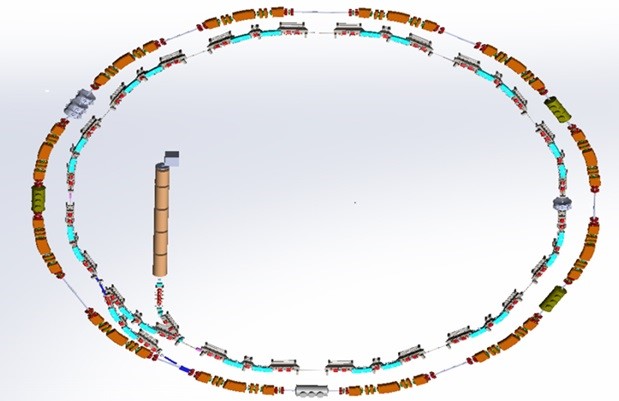
Figure – Structure of the RIF accelerator-storage complex.
The facility will also include a data processing center with a computing cluster using processors (CPUs) and graphics accelerators (GPUs) with a capacity of 0.57 petaflops.
CHALLENGES
Fundamental and applied scientific research related to solving current problems in modern materials science, biomedicine, and cultural heritage.
PARTNERSHIP PROPOSAL
Russian government
PARTNERS