SRF "SKIF"
Synchrotron Radiation Facility - Siberian Circular Photon Source "SKlF" Boreskov Institute of Catalysis of Siberian Branch of the Russian Academy of Sciences
Developing
The SRF SKIF is a large-scale facility with a 4+ generation synchrotron radiation source, which will be built in Koltsovo science city in the Novosibirsk region.
The accelerator complex of the SRF SKIF consists of an electron linear accelerator of 200 MeV, a full-energy synchrotron booster, and a storage ring. The storage of relativistic 3-GeV electrons, with a circumferenceof 476 m and an ultralow theoretical horizontal emittance of 73.2 pm rad (accounting for the current effects, betatron oscillation coupling, but neglecting insertion devices) will produce SR beams with a maximum brightness in the photon energy range from 100 eV to 100 keV for 30 experimental beamlines. For a photon energy of ~1.5 keV, the source emittance approaches the wave (diffraction) limit, providing a high degree of SR coherence thus expanding the research capabilities of the facility.
There are seven beamlines in the first phase which will be commissioned in 2026.
The unique characteristics of the new SR source will make it possible to conduct advanced research with bright and intense X-ray beams in a variety of fields – chemistry, physics, materials science, biology, geology, and the humanities.
| Commissioning: | 2026 |

Boreskov Institute of Catalysis
https://en.catalysis.ru/
SCIENTIFIC DOMAINS
Photon science, Synchrotron Light production, Materials Science & Engineering, Chemistry & Catalysis, Earth & Environmental Sciences, Structural Biology
Key words: Beamlines, synchrotron radiation, X-Ray optics, coherence, undulator, wiggler, diffraction, spectroscopy, microscopy, tomography
SCIENTIFIC GOALS
Access to New Science: to make the most out of the high brightness of a fourth-generation Synchrotron Light Source to explore techniques such as coherent scattering, nanofocus and inelastic scattering spectroscopy;
Improvement to Current Science: to provide access to enhanced versions of experimental techniques currently available through the high brightness and wide spectrum provided by the Source;
Innovation in Strategic Areas: to provide high-tech tools to solve problems in strategic areas for the Country.
FACILITIES
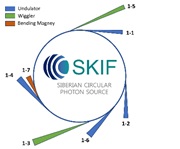
There are six beamlines with different scientific interests constructed in the first phase: 1-1 “Microfocus”, 1-2 “Structural diagnostics”, 1-3 “Fast processes”, 1-4 “XAFS spectroscopy and magnetic dichroism”, 1-5 “Hard X-ray diagnostics & imaging” and 1-6 “Electronic structure”, schematic view is presented in Figure 1. Due to the safety reasons and experiential peculiarities beamlines 1-3 and 1-5 are located in separate buildings (out of main storage ring building). Additionally, the beamline 1-7 “Base techniques of synchrotron diagnostics for educational, research and innovative activities of students” is constructed.

CHALLENGES
SKIF Challenges — key tasks for the infrastructure:
Advanced scientific research: conducting experiments in physics, chemistry, biology, medicine, and materials science using high-intensity X-ray beams.
Accelerator and beamlines operation: building and managing a state-of-the-art accelerator complex and specialized experimental beamlines.
Education and training: preparing students and young researchers to work with modern scientific equipment.
PARTNERSHIP PROPOSAL
PUBLICATIONS
https://sciact.srf-skif.ru/public
EVENTS
International Conference “Synchrotron Radiation: Science, Knowledge, Innovations, Future (SKIF-2026)” will be held on October 18−23, 2026 in Novosibirsk, Russia.
https://skif-conf.ru/